Why RHCP Antennas May Be a Better Option for UAV Links (Especially at 5 GHz)
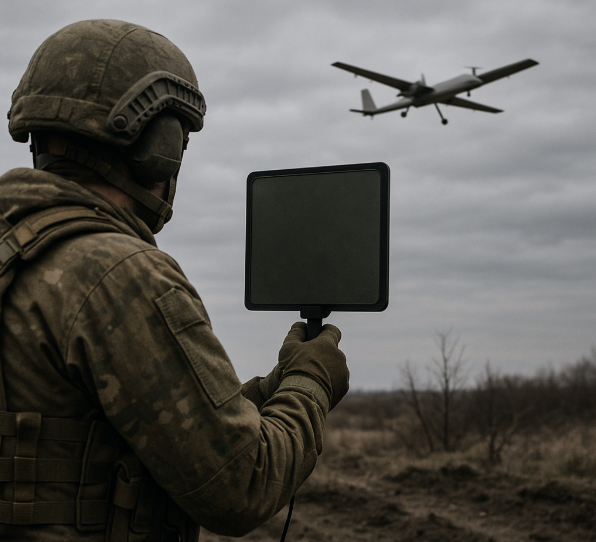
When choosing antennas for UAV communications, most people start with the obvious option: vertical linear antennas. They’re cheap, simple, lightweight, and on paper they can provide excellent performance.
But in real-world UAV flying — especially in the 4.4–5.0 GHz band — many teams find that RHCP (Right-Hand Circularly Polarized) antennas deliver a more reliable link, fewer dropouts, and more consistent performance over distance.
So why does RHCP often outperform “simple verticals,” even though circular polarization can introduce a 3 dB theoretical mismatch loss in some setups?
Let’s break it down.
The UAV Problem: Your Antenna Is Never Perfectly Vertical
In a lab, two vertical antennas remain aligned.
In the air, a UAV is constantly changing attitude:
Roll during turns
Pitch during acceleration, braking, and wind correction
Small oscillations from stabilization loops
Turbulence and gust response
Even a “stable” drone can easily see 10–30° of tilt in normal flight, and more during turns.
Why this matters for linear antennas
With two linear antennas, polarization loss increases as the relative angle increases:
30° misalignment ≈ 1.25 dB
45° misalignment = 3 dB
60° misalignment ≈ 6 dB
90° misalignment = deep null
That means a linear link can go from “great” to “terrible” just because the aircraft is turning.
RHCP solves this elegantly
With RHCP, you don’t care about roll angle in the same way.
Circular polarization is inherently more tolerant of UAV attitude changes — the link stays much more stable even as the drone rotates.
The Real Killer at 5 GHz: Multipath Fading
If you’ve ever seen a UAV link go from solid to broken in half a second, it usually wasn’t because the drone suddenly flew 500 m farther away.
It was multipath.
What is multipath?
Your receiver is seeing multiple versions of the same signal:
The direct path (line-of-sight)
A ground reflection
Sometimes reflections from trees, vehicles, buildings, or terrain
Those reflected paths arrive with different delays and phases.
At ~5 GHz, wavelength is ~6 cm — so small geometry changes cause large phase changes. This creates:
deep fades
rapid signal fluctuation
“perfectly fine… then suddenly dead”
Why rural environments can still be bad
People often assume rural = clean RF.
But rural often means:
a strong, clean specular reflection off the ground
fewer objects to scatter energy (so the reflection stays strong)
This can create a very strong secondary path — exactly what causes deep cancellation fades.
RHCP Helps Because Reflections Often Flip Polarization
Here’s the secret sauce.
When a circularly polarized wave reflects off the ground, it often comes back with the opposite handedness:
RHCP → reflection becomes mostly LHCP
Why this is good
If your receiver is RHCP, it naturally rejects LHCP energy.
That means:
the reflected signal contributes less to destructive interference
multipath fades become less deep
the link becomes more stable
This is one of the main reasons circular polarization is so popular in FPV systems — not because it magically increases range, but because it makes the range you already have more reliable.
The “3 dB Loss” Is Real — But It’s Predictable and Often Worth It
A common objection is:
“Isn’t circular polarization always 3 dB worse than linear?”
Only in a specific case:
one antenna is linear
the other is circular
both are ideal
In that case, yes — the mismatch is always 3 dB.
But here’s the practical point:
Linear-linear isn’t “0 dB loss”
Linear-linear is only perfect when the drone stays aligned and multipath is mild.
In reality, linear links often experience:
6 dB loss from attitude
10–20 dB fades from multipath
nulls from antenna pattern distortion due to tilt
So the real comparison is:
RHCP: constant penalty, but stable
Linear: sometimes better, sometimes catastrophically worse
In most UAV missions, stable wins.
RHCP Works Better with Diversity Systems
If you’re using:
dual antennas on the ground
a diversity receiver
or multiple ground stations
RHCP makes those systems work even better.
Why?
Diversity works best when the fades on each antenna are uncorrelated.
RHCP reduces multipath dominance and improves the odds that at least one antenna has a clean signal.
Common strong combinations include:
RHCP omni + RHCP patch (close-in + long range)
two RHCP antennas spaced apart
two RHCP patches at different angles
RHCP Makes Directional Antennas More Useful
At 5 GHz, using a directional ground antenna (like a patch or helical) is one of the best ways to improve range.
RHCP directional antennas have two big advantages:
They concentrate energy toward the drone
They reduce reception of reflected energy from the ground
This combination is extremely powerful at 500 m and beyond.
Why This Matters at 4.4–5.0 GHz and 500 m
At 500 m on 5 GHz, your link budget is often “fine” in theory.
But real-world failures usually happen because of:
momentary fades
roll-induced polarization mismatch
ground reflections
imperfect antenna patterns
RHCP doesn’t eliminate these issues, but it reduces the severity of the ones that most commonly cause dropouts.
Practical Recommendation for UAV Links
If you want the most reliable setup in rural conditions at 4.4–5.0 GHz:
Best all-around setup
RHCP on the UAV
RHCP on the ground
Preferably with ground diversity
Even better
UAV: RHCP omni
Ground: RHCP patch (aimed) + RHCP omni (diversity)
Avoid this if possible
UAV RHCP + Ground vertical linear
Works, but you take the constant 3 dB hit.
Conclusion: RHCP Is About Reliability, Not Raw Gain
Vertical linear antennas can be excellent in controlled conditions.
But UAV flight isn’t controlled.
In real airframes and real environments, RHCP often provides:
✅ better attitude tolerance
✅ reduced multipath fading
✅ fewer sudden dropouts
✅ more consistent range
✅ improved performance with directional ground antennas
Even if the theoretical link budget looks slightly worse, the actual link tends to be better.
So if you would like to know more about our RHCP Antennas drop us a line at support@apella.co.uk